


Strait of Hormuz
Syllabus: GS1/Geography
Context
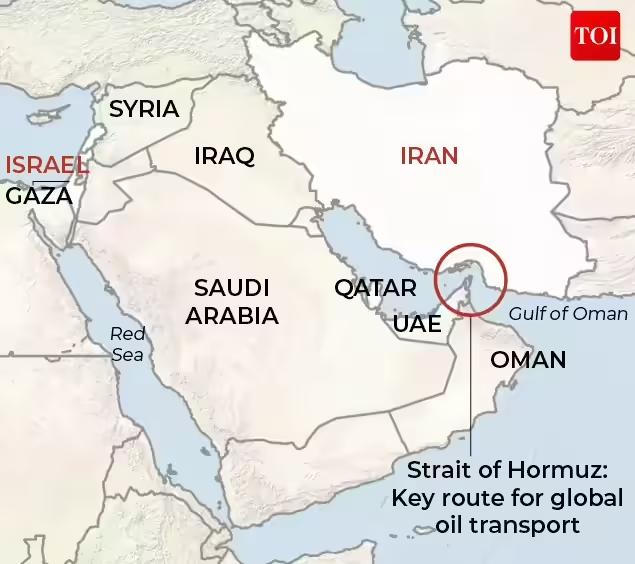
- The war in West Asia has impacted trade through the Strait of Hormuz.
About
- The Strait of Hormuz lies between Iran to the north and Oman and the United Arab Emirates to the south, linking the Persian Gulf with the Gulf of Oman and the Arabian Sea.
- At its narrowest point it is about 33 kilometres wide, with shipping lanes just a few kilometres across in either direction.
- Nearly half of India’s crude oil and around 60 per cent of its natural gas imports pass through the strait.
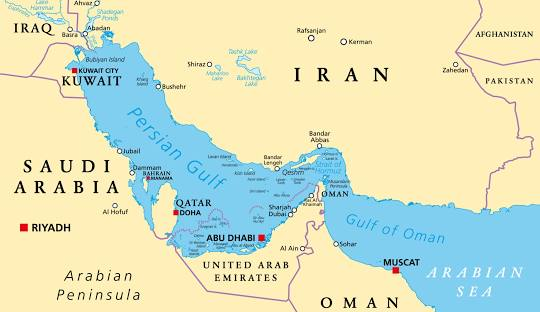
Persian Gulf
- The Persian Gulf lies between Iran (north) and the Arabian Peninsula (south).
- It connects to the Arabian Sea through the Strait of Hormuz, one of the world’s most critical maritime chokepoints.
- The Persian Gulf is the most important source of oil and gas for India.
- Around 90% of India’s imports of LPG, 40% of its LNG and 35% of its crude oil came from the Persian Gulf in 2025.
Source: IE
Iranian Kurds
Syllabus: GS2/IR
Context
- U.S. President Donald Trump encouraged Iranian Kurdish forces to launch attacks against Iran as conflict in West Asia widened.
About
- Kurds: The Kurdish people are an ethnic minority group in the Middle East without an independent state.
- The population ranges between 25 million and 45 million worldwide, with most living in the mountainous region across parts of western Iran, eastern Turkey, northern Iraq and Syria, and Armenia.
- They speak various Kurdish dialects, not related to Turkish or Arabic; and are mostly Sunni Muslims.
- Turkey has the largest population of approximately 15 to 20 million people while Iran has 8-12 million Kurds.
- Concerns of Kurds: They were promised a nation post-WWI, but never granted.
- They faced rebellions, state suppression of language and culture.
- Kurdistan Regional Government: Following years of conflict and the 1991 Gulf War, the Kurds established the Kurdistan Regional Government (K.R.G.) in Iraq, which is now a constitutionally recognised autonomous region.
- In the ongoing Israel-Iran-U.S. conflict, the Kurds might be viewing an opportunity to take down the Iranian regime and achieve autonomy.
Source: TH
Raisina Dialogue 2026
Syllabus: GS2/International Relations
Context
- PM Modi attended the inaugural session of the Raisina Dialogue 2026 in New Delhi.
- The theme for 2026 edition is “Samskara: Assertion, Accommodation, Advancement.”
Raisina Dialogue
- The Raisina Dialogue is India’s premier conference on geopolitics and geoeconomics committed to addressing the most challenging issues facing the global community.
- It brings together global leaders, policymakers, diplomats, scholars, and strategic experts to discuss major international challenges.
- The first session was held in 2016.
- It is hosted by the Delhi-based Observer Research Foundation, in collaboration with the External affairs ministry of India.
Source: DD News
Gravity Bomb
Syllabus: GS3/Science and Tech
Context
- US Secretary of War, Pete Hegseth announced that the US would be shifting to ‘gravity bombs’, marking a major tactical pivot in the ongoing campaign against Iran.
What is a Gravity Bomb?
- A gravity bomb (or free-fall bomb) is an unpowered munition dropped from an aircraft. Unlike cruise missiles such as the Tomahawk cruise missile, it has no engine and falls toward the target under gravity, guided by the aircraft’s speed and altitude.
- Despite their World War–era origins, gravity bombs remain widely used by the United States Air Force in conflicts such as Iraq, Afghanistan, and Syria.
- Modernisation: Many gravity bombs are fitted with Joint Direct Attack Munition (JDAM) kits, which use GPS and steerable fins to convert them into precision-guided munitions.
- Types: The United States widely uses the Mark 80 series, including;
- Mk-82 (500 lb): Soft targets such as vehicles or radar sites.
- Mk-83 (1,000 lb): Reinforced structures and command posts.
- Mk-84 (2,000 lb): Bunker-buster for hardened facilities.
- Key Feature: Gravity bombs are relatively cheap ($25,000–$30,000 with JDAM) but require aircraft to fly close to targets, making them effective mainly when air superiority is achieved.
Source: IE
India’s 7th National Report to the Convention on Biological Diversity
Syllabus: GS3/ Environment
Context
- India has submitted its 7th National Report to the Convention on Biological Diversity (CBD), assessing national progress toward biodiversity targets for 2030.
About
- The report evaluates India’s performance against 23 National Biodiversity Targets (NBTs) aligned with the Kunming–Montreal Global Biodiversity Framework (KMGBF).
- It finds that only two targets are clearly on track, despite improvements in policy frameworks, forest cover, and ecosystem restoration.
Convention on Biological Diversity (CBD)
- Origin: The Convention was opened for signature in 1992 at the United Nations Conference on Environment and Development (Rio Earth Summit).
- The Convention on Biological Diversity (CBD) entered into force on 29 December 1993.
- The first session of the COP was scheduled in 1994 in the Bahamas.
- Secretariat: Montreal, Canada.
- Ratification: The CBD has been ratified by 196 nations, making it one of the most widely adopted international treaties.
- The United States is the only UN member state that has not ratified the convention.
- It has 3 main objectives;
- The conservation of biological diversity
- The sustainable use of the components of biological diversity
- The fair and equitable sharing of the benefits arising out of the utilization of genetic resources.
- The governing body is the Conference of the Parties (COP), which meets every two years.
- The Cartagena Protocol on Biosafety and the Nagoya Protocol on Access and Benefit-Sharing are supplementary agreements to the CBD.
Kunming-Montreal Global Biodiversity Framework
- The Kunming-Montreal Global Biodiversity Framework was concluded at COP15 of the Convention on Biological Diversity (CBD), held in Montreal, Canada, in 2022.
- This framework is a landmark agreement aimed at addressing the global biodiversity crisis.
- It features 23 targets to be met by 2030 and four global goals for 2050 to preserve biodiversity for current and future generations.
- The agreement is not binding on members.
Source: DTE
Previous article
Use of AI in Healthcare
